The Library still held events, though entirely virtual. Our Library collaborated with the Anthropology Department to create a Student Virtual Art Gallery exhibit in August 2020.
Our Library Diversity, Equity, and Inclusivity committee held an online Human Books series in September 2020, interviewing students and members of the campus community with diverse backgrounds.
We also held our annual Geneseo Authors celebration virtually, with congratulatory videos from our Provost and President in November 2020. We created a site displaying published works by faculty, staff, and students from 2020, including links to the works’ DOI and online access.
Student Virtual Art Exhibit, Watercolor, August 2020
Student Anthropology Virtual Art Exhibit, Figure Drawing, August 2020
Human Books Event, SUNY Geneseo Library, Fall 2020
Human Books Event Promo, Fall 2020
Geneseo Authors Celebration 2020
The Library was still in its temporary location in Sturges when the Fall 2020 semester began. Most of the staff were still working from home, but some—notably, Access Services staff—were spending part of their time working in Sturges (it was a “hybrid” semester, after all). Even though limited, there was a small physically circulating collection available (the flagged books and items), electronic versions of items were available, and instruction and consultations were ongoing.
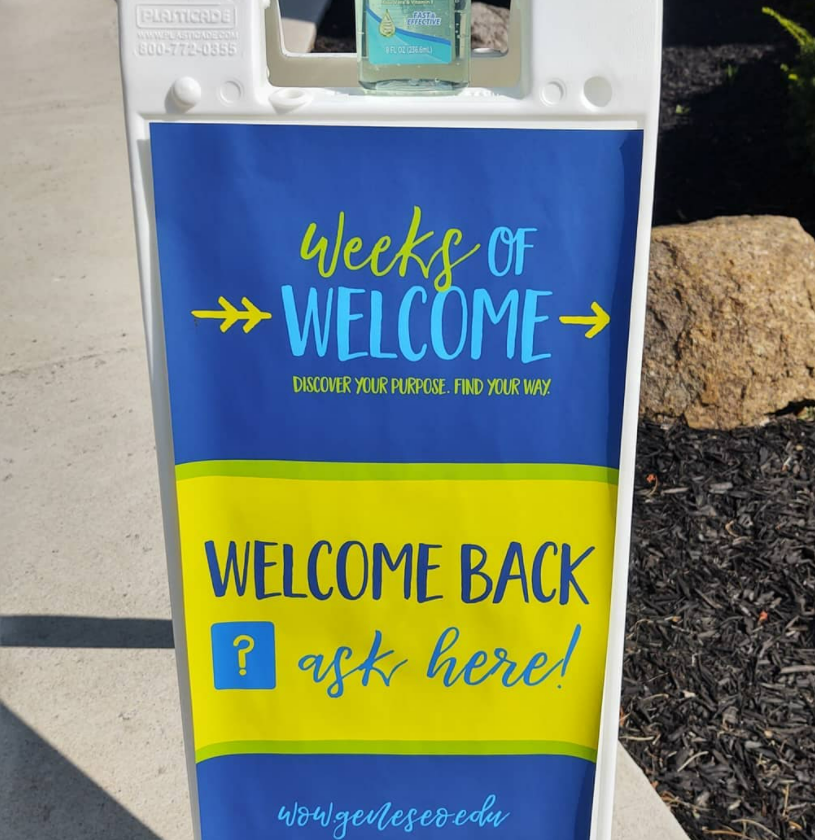
Weeks of Welcome sign for celebrating start of Fall 2020 Semester
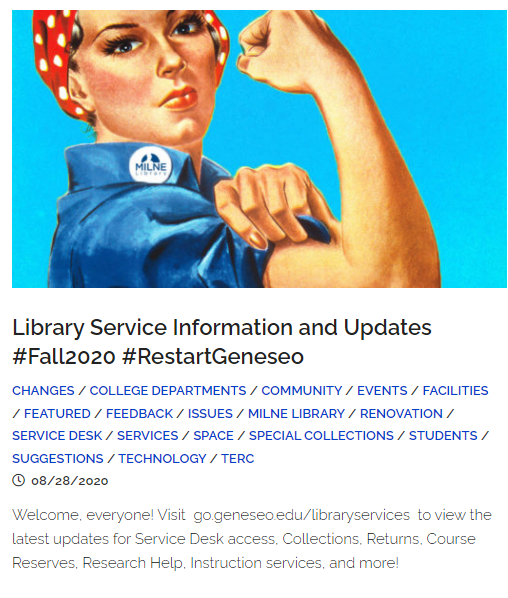
Fall 2020 MilneStrong Rosie Riveter graphic
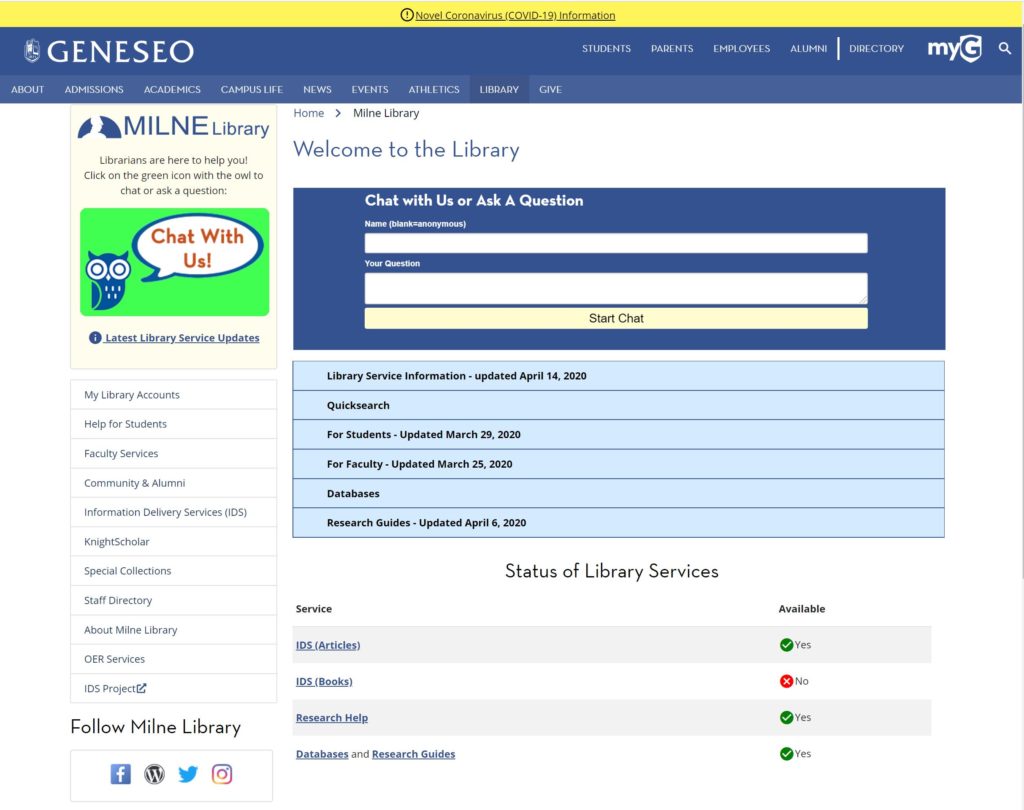
Library Home Page August 2020 with service update links
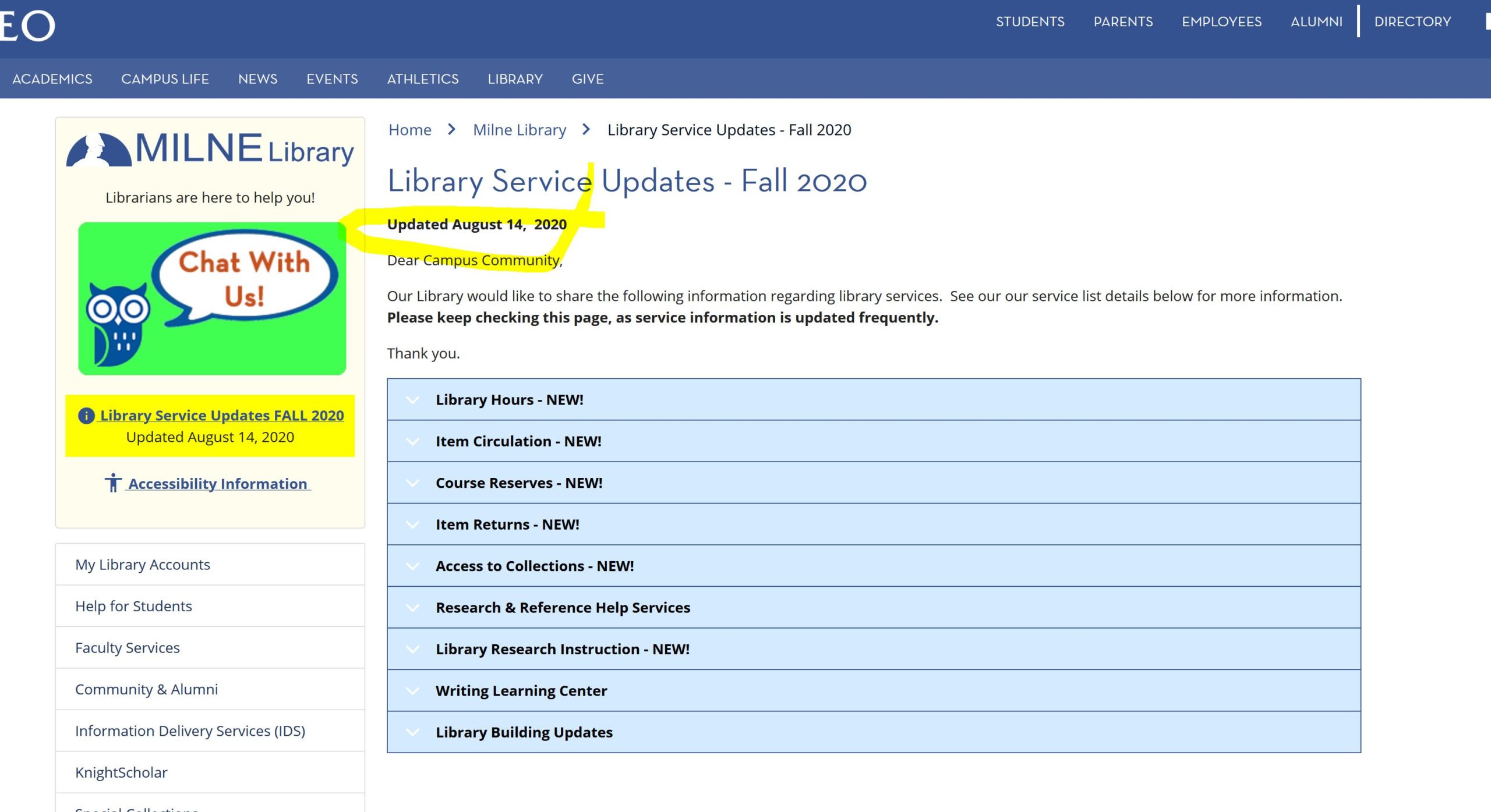
Library Service Updates page beginning of Fall Semester 2020
August 2020 updated Library catalog holdings for electronic and available physical materials
IDS InterLibrary Loan and Physical Item availability update for Fall Semester 2020
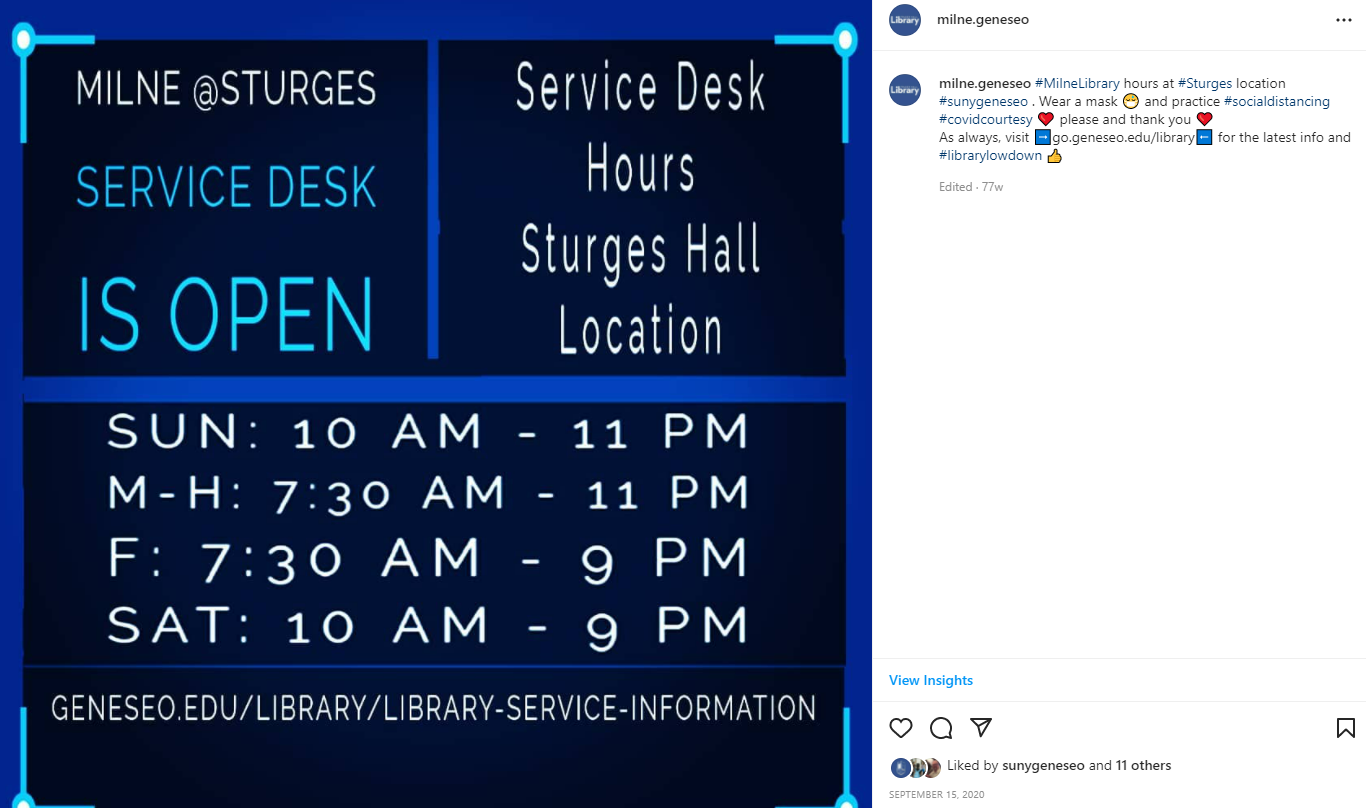
Sign for Library Sturges Hall Service Desk Hours Fall Semester 2020
Starting in June 2020, eight library staff members began a project to flag more than 100,000 books, using blue painter’s tape, to indicate which books in the main circulating collection should be cleaned of asbestos and retrieved from Milne Library. The 100,000 books were selected based on circulation history, date of publication, availability among SUNY libraries, local and regional value, date of purchase by the Library, and titles selected by faculty for retention.
Armed with dozens of rolls of painter’s tape, clipboards, lists, and pencils, the staff visited Milne daily for the next two and a half months to apply one-inch strips of tape to book spines. After flagging was complete, staff went through the stacks again to verify that books not found on the shelf were truly missing and not simply misshelved. The staff spent an estimated 1,384 hours flagging books.
Why painter’s tape? Library staff were instructed to not disturb anything in the building for fear of spreading asbestos dust. Books could not be moved and painter’s tape was determined to be the most effective way to label books without violating asbestos protocol or harming the books.
Milne 104C- Books flagged for retrieval from Milne Library building, June 2020
Special Collections artwork, documents, maps awaiting retrieval from the Milne Library Building, June 2020
Books, materials, and cabinets Milne Library 110 being prepared for retreival, June 2020
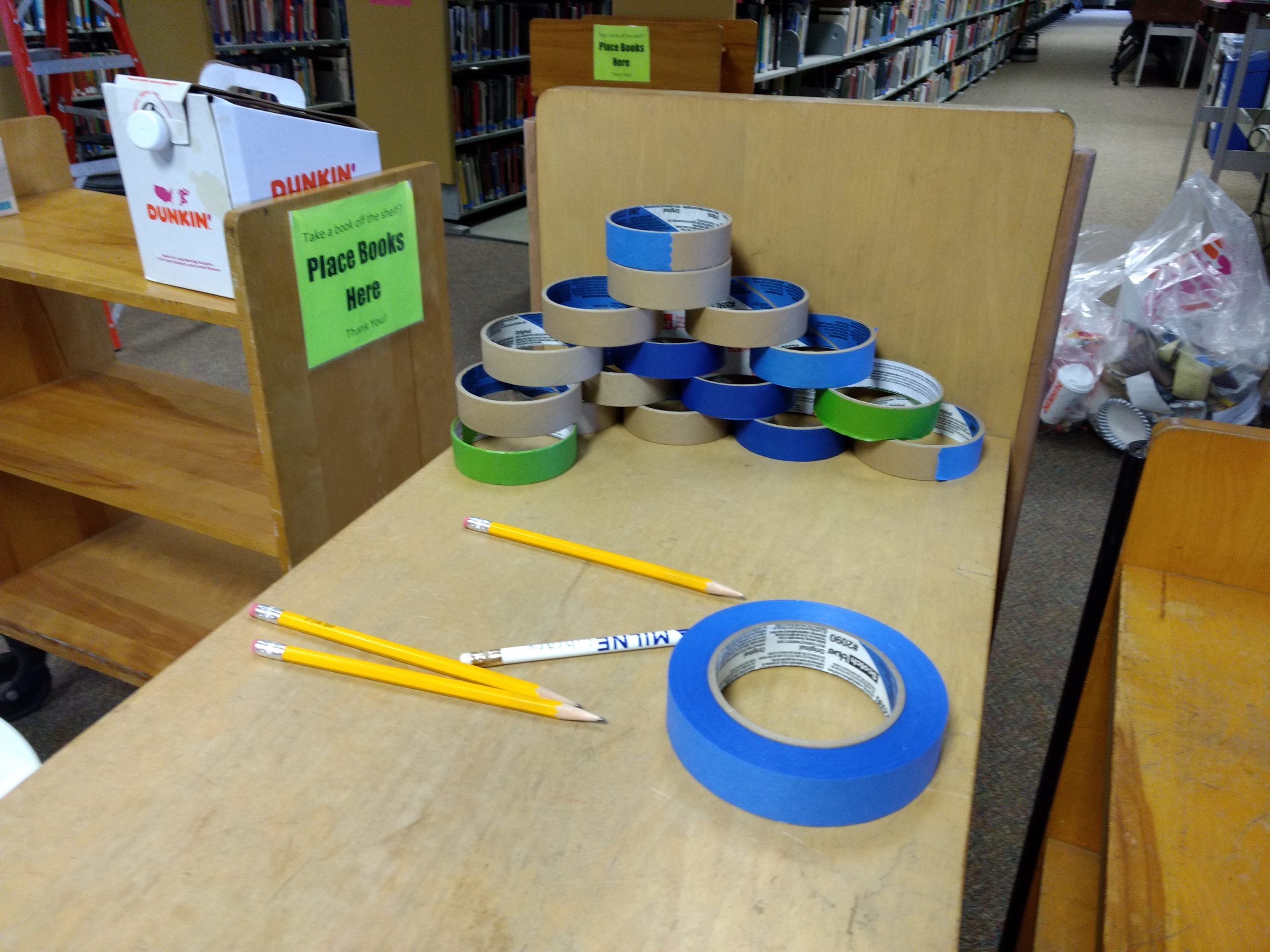
Painters tape for safely flagging thousands of books to be retrieved from Milne Building
Some of the thousands of books flagged for retrieval from the Milne Library Building, Summer 2020
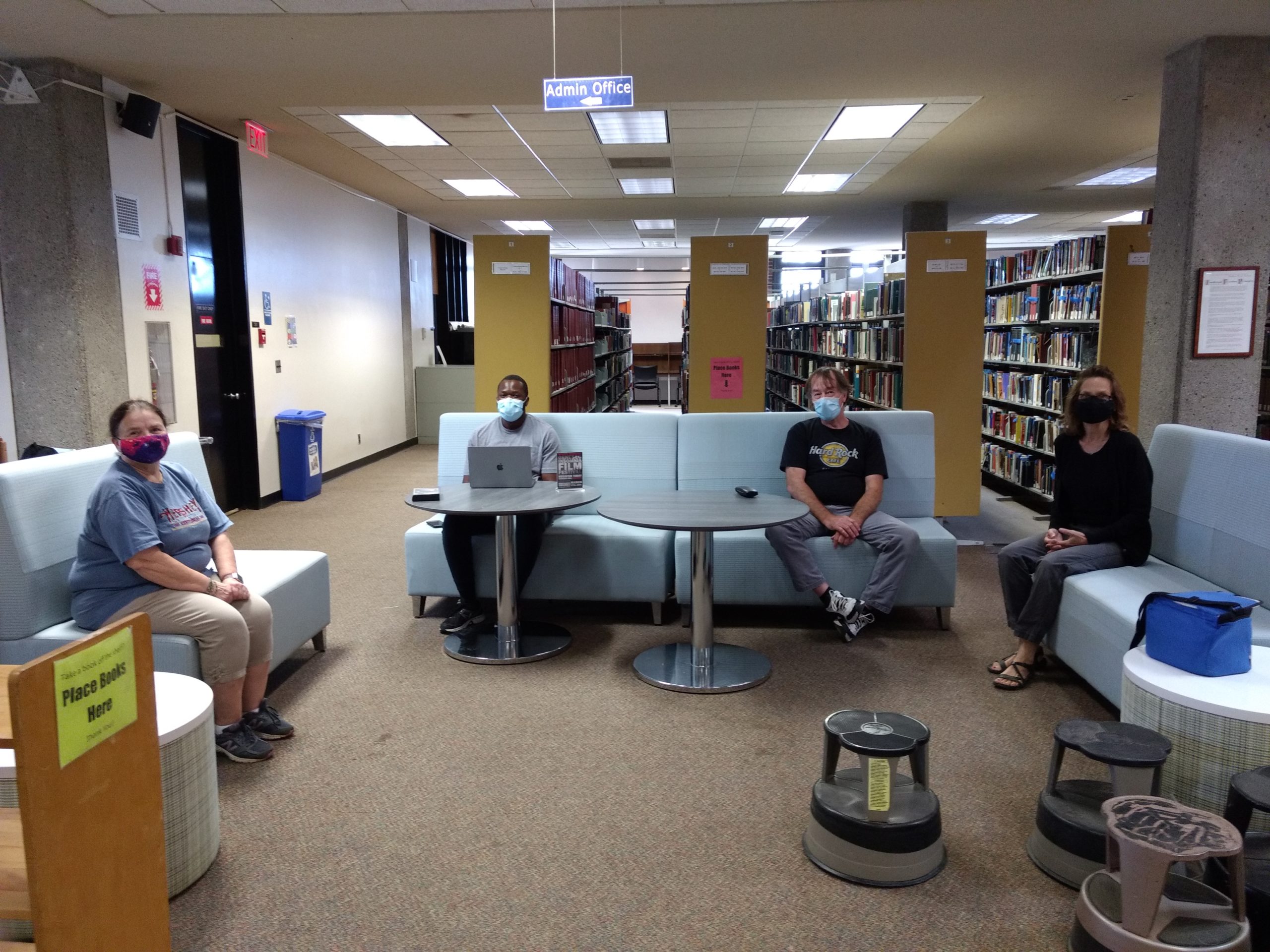
Library Staff practicing safe social distancing, Summer 2020
Long shelving stacks of books flagged with blue painter tape for retrieval from the Milne Library Building, Summer 2020
Books flagged with blue painter tape for retrieval from the Milne Library Building, Summer 2020
LIbrary Staff taking a break from flagging items to retrieve from the Milne building, summer 2020
Books flagged with blue painter tape for retrieval from the Milne Library Building, Summer 2020
Taking a well-deserved cake break to celebrate Dan's birthday, July 2020
Librarians planned for the inevitable reduction of the main circulating collection. Using data gathered from the current library catalog and data harvested from the previous system, as well as a holdings analysis conducted by SUNY Library Services to identify which titles had few or zero holdings within SUNY, librarians put together several scenarios to share with campus project stakeholders. Regardless of which scenario was selected, the collection would have to be reduced in size to fit into any temporary location on campus while Milne Library underwent abatement and renovation. The College Archives and Special Collections and the TERC collection would remain intact.
Collection decisions were made based on the following factors:
Books purchased in the last five years
Books of local or regional value
Books with few holdings in SUNY libraries
Books with circulation history:
Natural sciences: books with circulation history in the last five years
Social sciences: books with circulation history in the last seven years
Humanities and Mathematics: books with circulation history in the last ten years
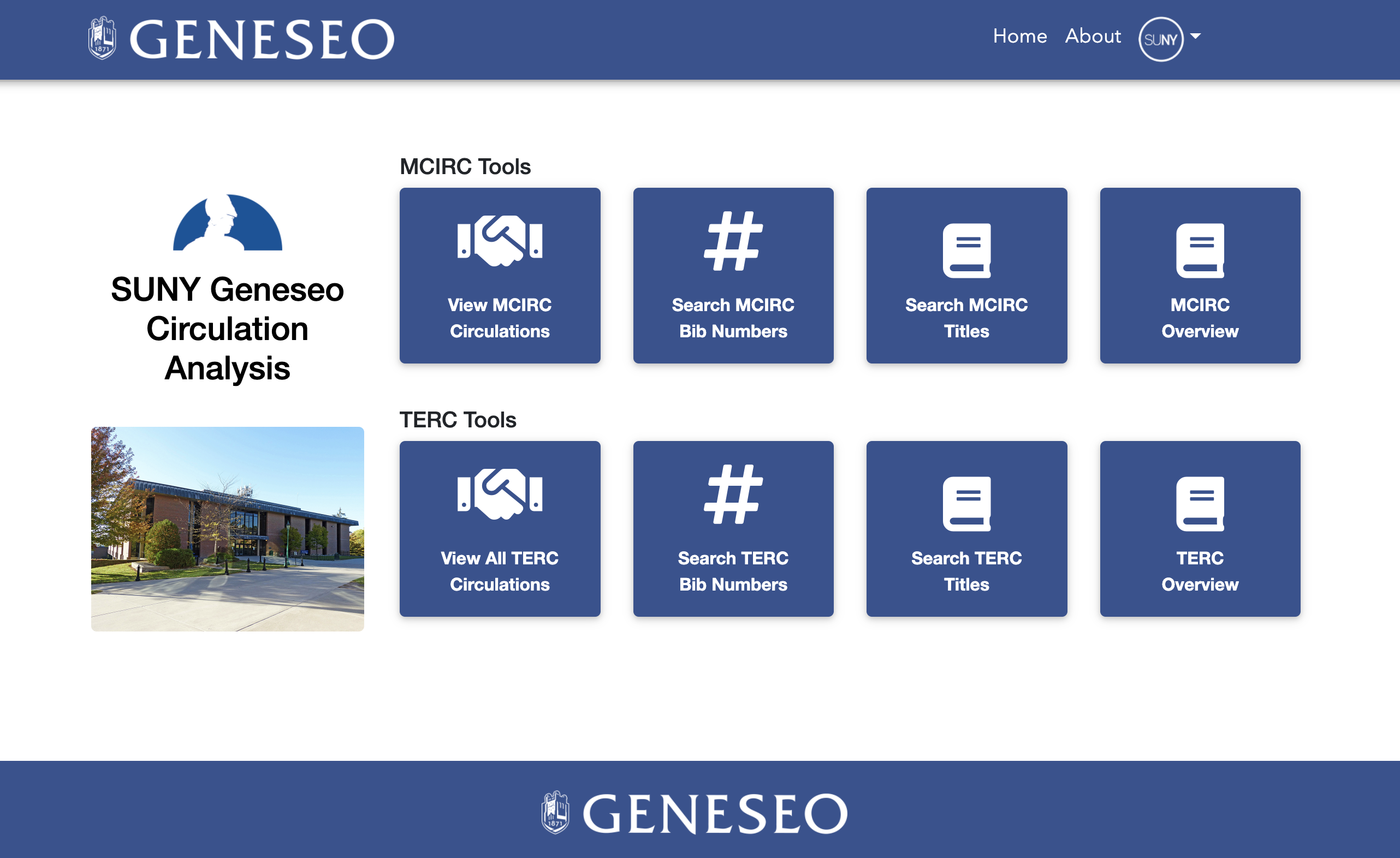
To make the process more efficient and save valuable hours, Bill Jones, Digital Resources and Systems Librarian, created a data dashboard to search and analyze usage data from the legacy catalog system with an option to export data in a meaningful report.
Circulation by Count March 2020
Circulation tracking interface March 2020
Circulation chart
Select Titles for Library Circulation
Librarians invited faculty to review a list of potential weeding candidates and solicited input on the titles intended for retention. Alana Nuth sent a message to department chairs, deans, and directors on March 26, 2020 to invite faculty to view a list of books that would be otherwise disposed. An Excel file was sent with the message, listing titles intended for retention and a link to a library catalog profile which listed only books intended for withdrawal. Faculty could search and browse this special catalog view and flag titles for retention by clicking a purchase request button that had been customized for this exercise. Faculty were given until May 1, 2020 to make their selections.
Library ITS set up a separate Answers Queue for students asking how to return books, and posted method returns on our website and social media. The book drop bin, located outside Sturges Hall, was closed on March 22, 2020. It would be reopened on May 13, 2020, to accommodate students returning to campus in pre-scheduled time slots to move out the rest of their belongings—and hopefully return borrowed library materials. Access Services staff began coming periodically to campus to empty the bin and put the books into quarantine in Sturges.
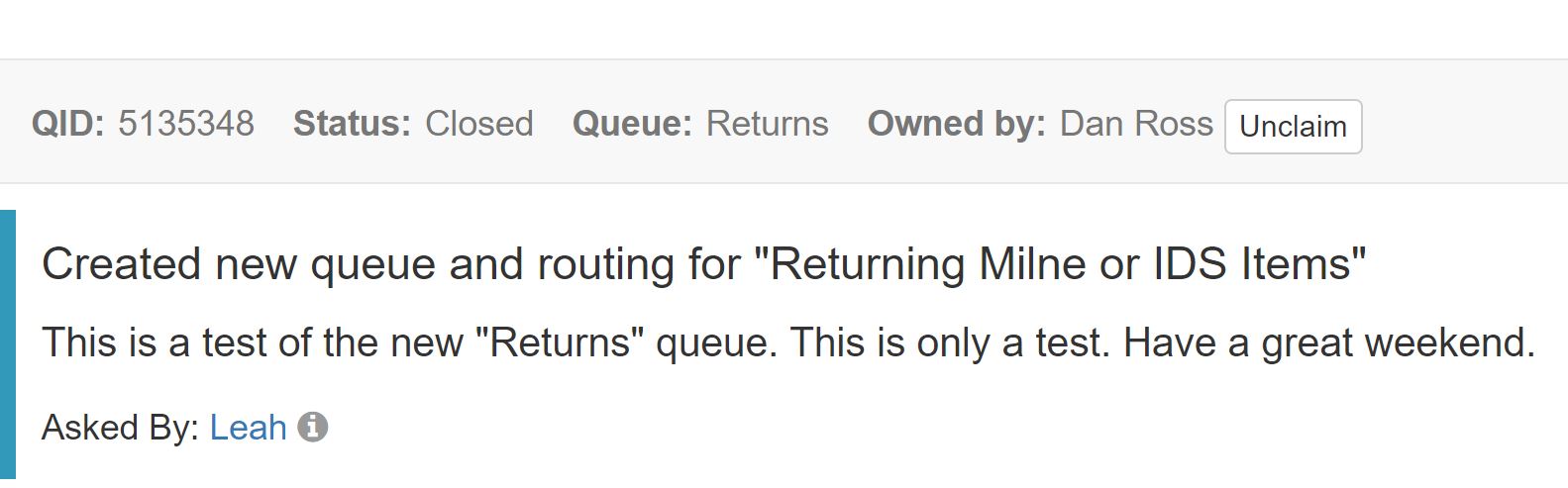
Test of the new Returns Question and Answer queue
Returns Question and Answer , March 2020
Returns and IDS InterLibrary Loan Question and Answer, March 2020
Returns and Due Dates question and answer during COVID shutdown
Instagram post May 2020 noting Book Drop on campus is open
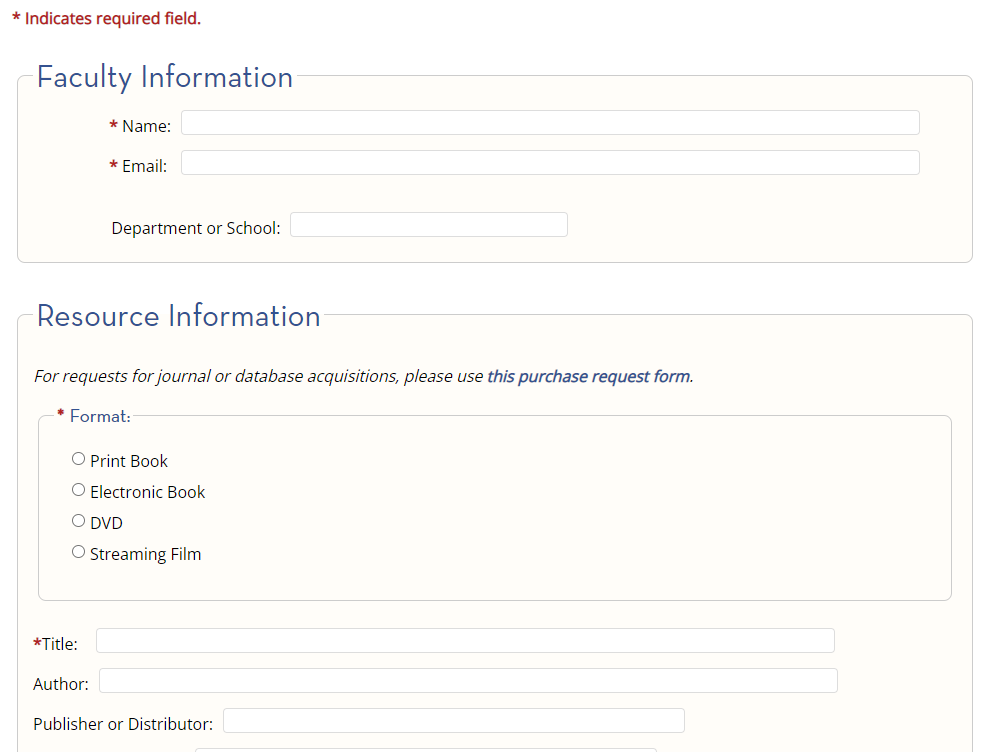
On March 20, 2020, the Library’s head of Collection Management notified faculty that, for the remainder of the Spring 2020 semester, Milne Library would be purchasing electronic books and streaming access to films rather than print books or DVDs, and included a link to a purchase request form for titles the Library did not already have access to.
Library Book Purchase Request Form
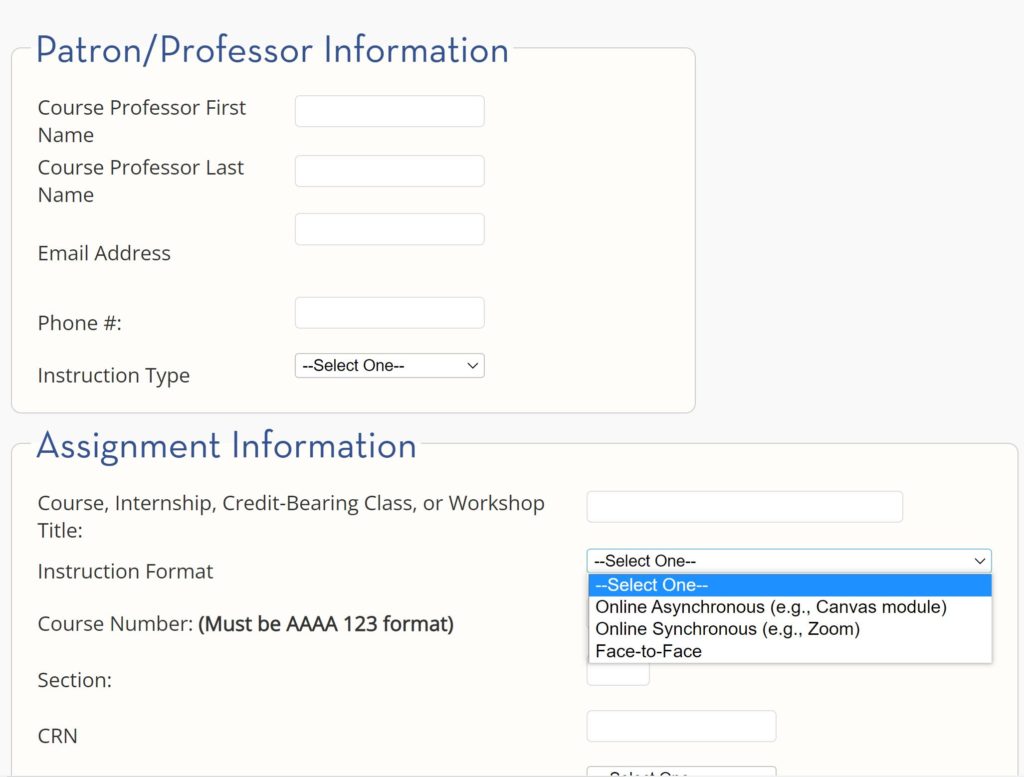
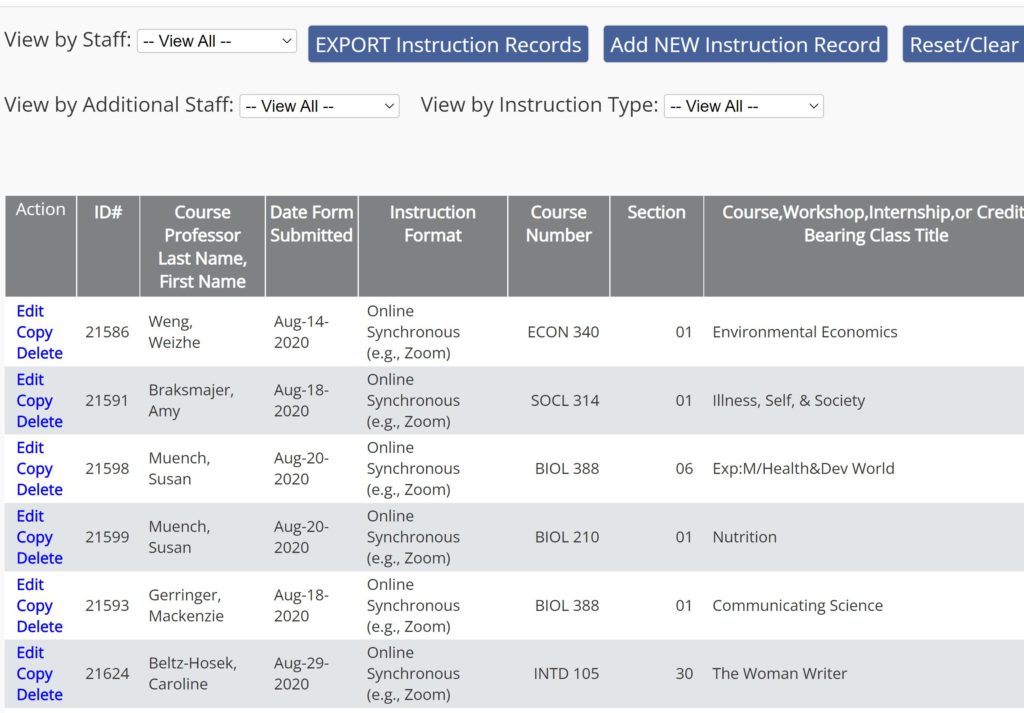
Research Instruction librarians, along with the rest of Geneseo’s teaching faculty, prepared to make the switch to remote instruction. CIT provided webinars, tutorials, guides, and other assistance for getting up to speed with Canvas, Zoom, and other technologies useful for teaching online. Our Library IT/Web Services Developer, Leah Root created Zoom Asynchronous and Synchronous options for Library Instruction requests in our custom Library DataPortal web application and database system. Library Instruction continued in this mode through the Spring and Fall 2020 semester.
Library Instruction requests with online synchronous and asynchronous optionsDataPortal Library Instruction Requests with Online Asynchronous Format Option
As an alternative to in-person research help drop-in hours, Research Instruction librarians provided research help services to students and faculty using virtual chat and the Library’s Ask a Question form, a service that directs patrons to submit a question which would be answered via email.
Students were still able to meet face-to-face with librarians for more involved research consultations, but the meetings would be conducted virtually. Initially, Google Hangouts or G-Chat were the options offered, because students had access to these platforms without the need for any new technology. Not long afterward, when the College purchased a “deluxe” Zoom subscription, more consultations took place there. Leah Root, Library IT/Web Services Developer, embedded a Zoom link in the consultation confirmation to make it easy for students to join.
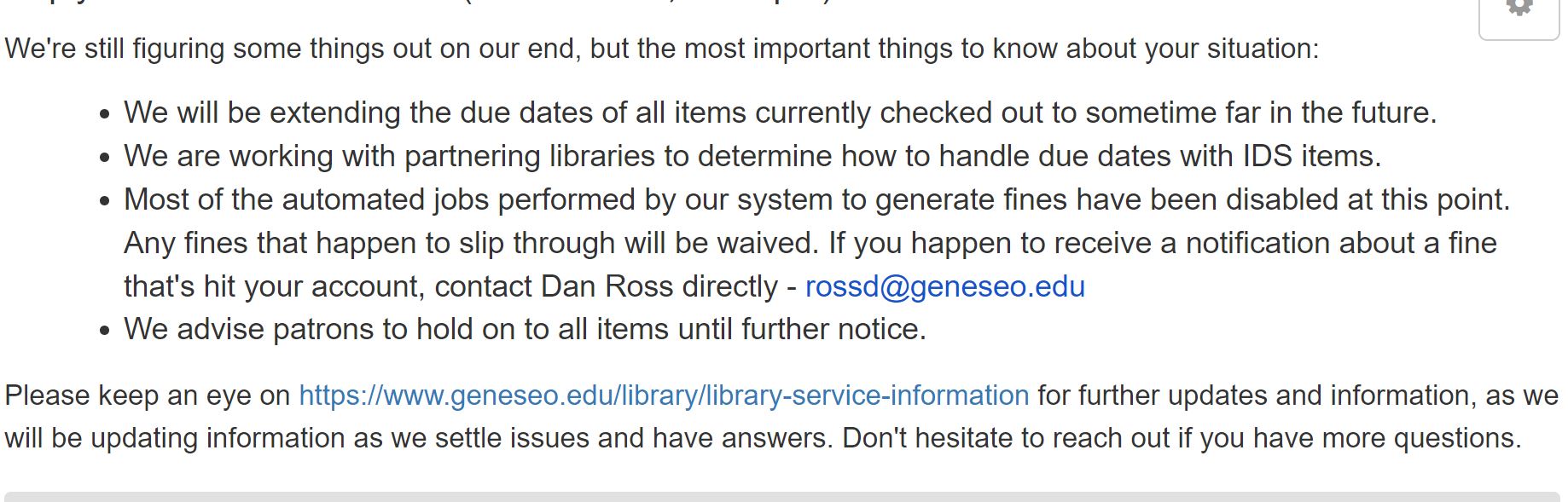
During the Remote Learning Period (Spring 2020 Semester), the Library would continue to provide access to journal articles and books that could be delivered electronically, via its Information Delivery Services (IDS). Due dates were extended for books that had been borrowed, either from Milne or from other libraries via IDS, prior to the campus closing.
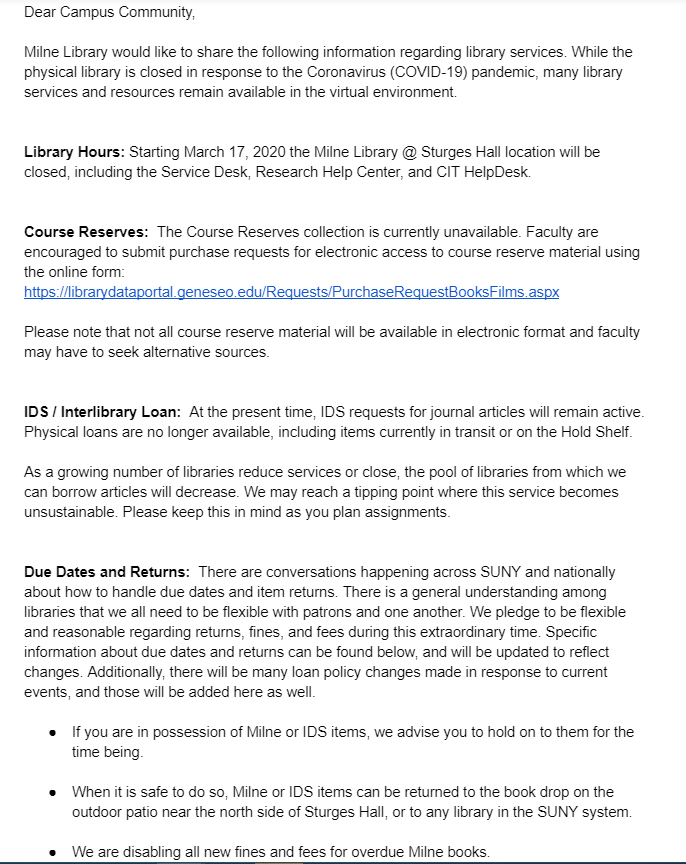
Letter and website post about item returns and electronic resources , March 17, 2020
The campus was closing down. The morning of Tuesday, March 17, 2020, was the last time library staff gathered for a meeting in Sturges. Immediately afterward, staff packed up their work things, completed the necessary forms for working from home, and left. For the remainder of the spring semester, at least, the Research Instruction, Collection Management, Information Technology, and Administration units would transition entirely to remote work.
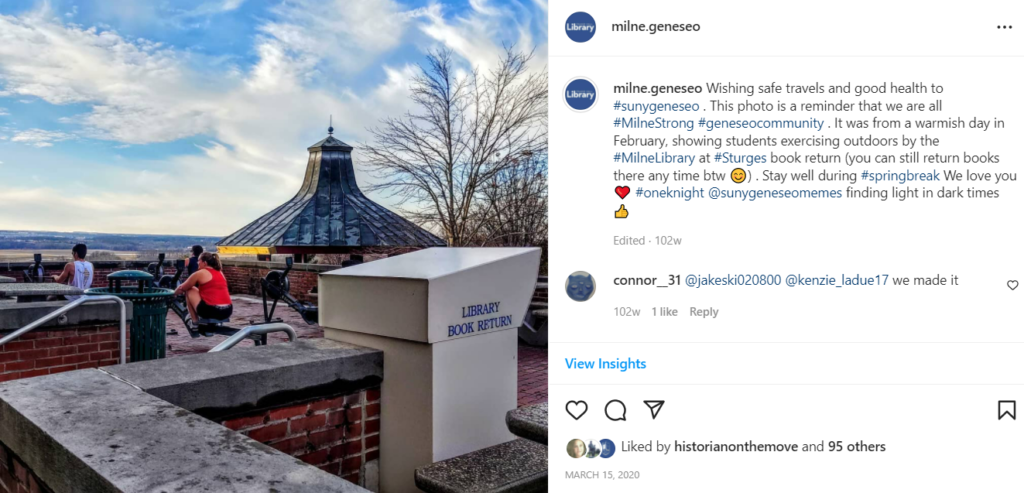
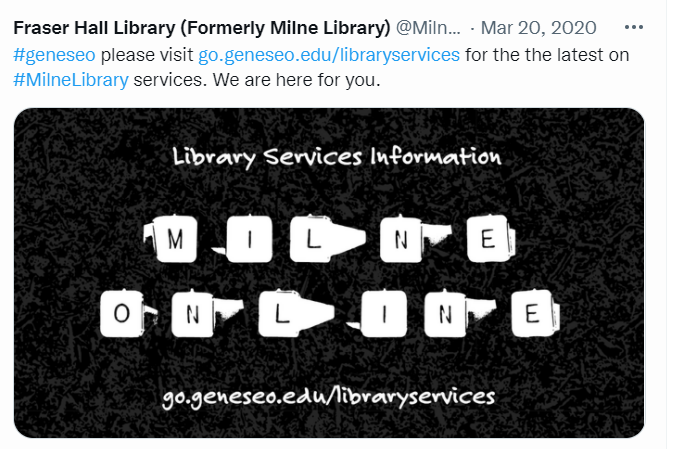
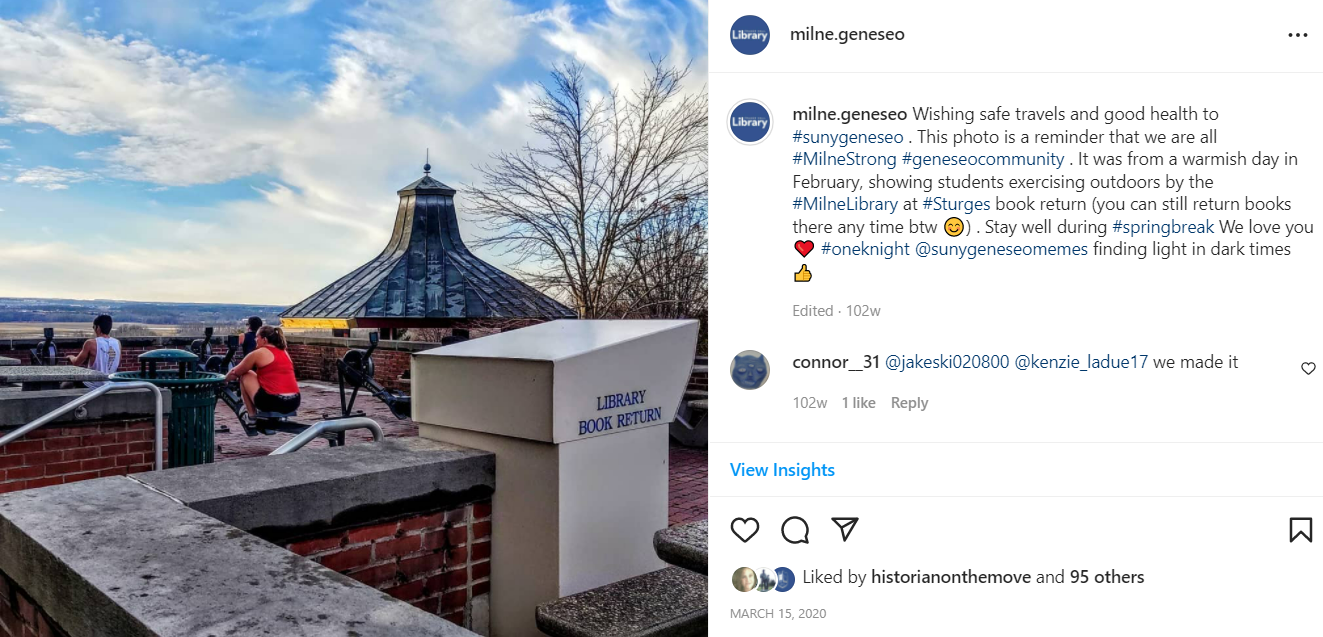
Library Services and Encouragement Tweet, March 2020Governor announcement of NY State COVID shutdown March 17, 2020Instagram “this is not goodbye” style post from the Library to campus, March 15 2020